Poll-Parrot through the decades
A century onsmall feet
Before children asked for a star's sneaker, they asked for a parrot. Poll-Parrot shoes were the bright leather on American playgrounds when St. Louis still shod the country. We still make shoes for growing feet. The parrot never left the perch.
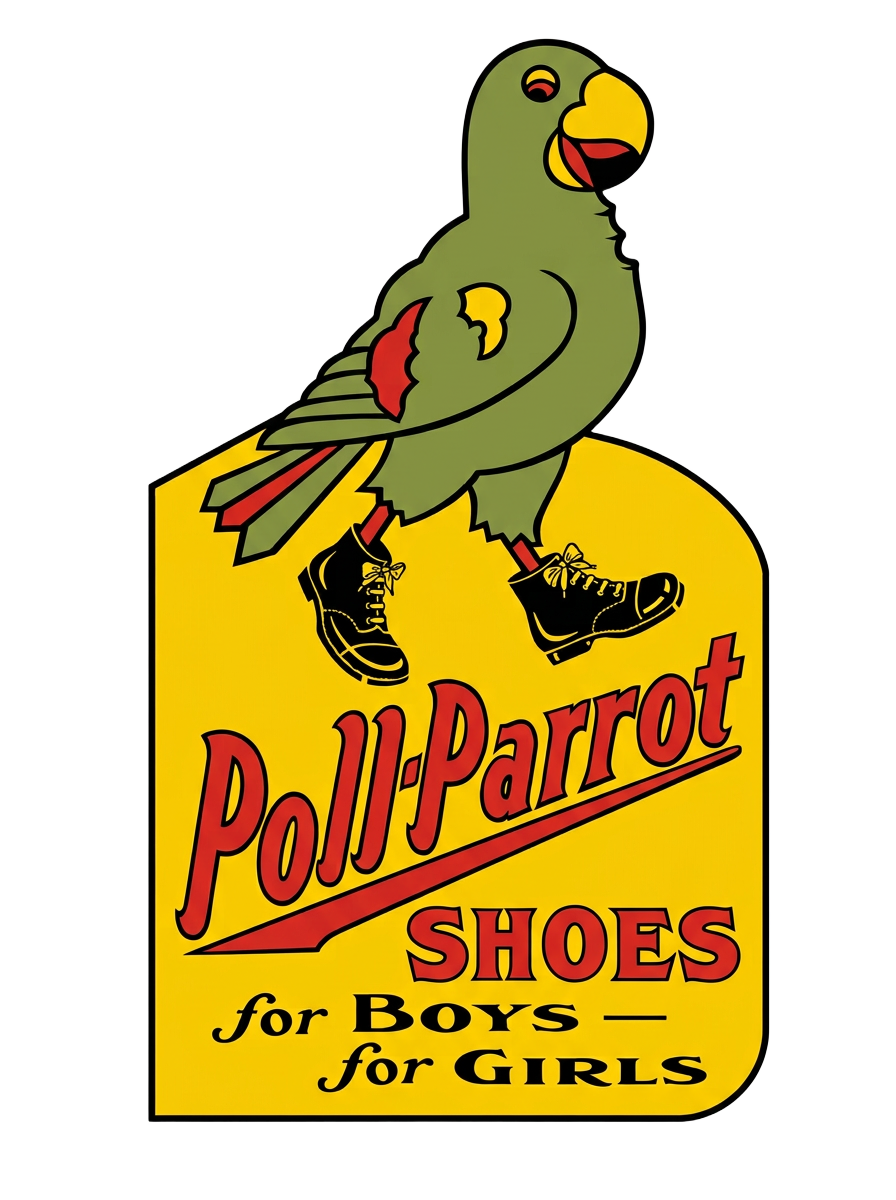
1898–1925
A man, a bird, a name
Paul Nelson Parrott opened a shoe shop in Knoxville and kept a live parrot on the floor — a joke that walked. “Poll parrot” was already ordinary English for a tame talking bird, a cousin of “Polly.” A salesman suggested putting the joke on a children's line. Paul agreed. The name was copyrighted in 1925. The mark was a red, green and gold bird on a perch and the line Poll-Parrot Shoes for Boys and Girls. The slogan was not a jingle. It was a dare: They speak for themselves.
1898–1986
Born in Scott County
The story does not start in a boardroom. It starts in Oneida, Tennessee.
Paul was born 24 April 1898 in The Oneida House — the town's first motel, a three-story building that also held Oneida's first restaurant — run by his father, William Nelson Parrott. His mother, Lucy Katherine “Cassie” Byrd (c. 1878–1961), was a Scott Countian, daughter of Milton Asbury Byrd and Nancy Chitwood of Helenwood. William and Cassie married in Roane County in 1896.
William died in 1901, aged 35, and is buried at Marcum Cemetery beside their infant daughter Pauline. Cassie sold the house to Eli Cooper — father of H.F. Cooper, who built much of downtown Oneida — and the place became the City Hotel. She later married William B. Flenniken and moved the family to Knoxville. Paul grew up there, married Neel Reynolds, and from that Knoxville shop built the brand that would cover the country. He died 9 January 1986 and is buried at Woodlawn Cemetery in Knoxville with his wife, his mother and his stepfather.
Poll-Parrot is a national children's shoe. It is also a Scott County birth.
1898–1928
St. Louis made the shoes America wore
From about 1870 to 1950, St. Louis was the shoe capital of the United States. Manufacturers followed immigrant labor — much of it German — and new factory methods west from high-wage New England. By 1905 the city produced one-sixth of all American shoes.
Roberts, Johnson & Rand, formed in St. Louis in 1898, became one of the largest shoemakers of its time. In 1911 it merged with Peters Shoe Company as International Shoe Company. Friedman-Shelby followed in 1912. Divisions kept their own brands. ISC grew into the largest shoe manufacturer in the world. The Hannibal, Missouri plant — running since 1898, a million pairs a year by 1908 — made Poll-Parrot and Star Brand children's shoes.
Trade papers show Poll Parrot as a companion to Star Brand as early as a Boot and Shoe Recorder notice of 26 November 1921, and newspaper advertising was national by 1922. Accounts differ on the exact handoff: some say Paul Parrott made the line in St. Louis from 1922 and sold it to ISC in 1928; others say ISC bought Parrot Shoe Company in 1925. What is solid is this: by the late 1920s Poll-Parrot sat inside International Shoe, beside Star Brand, advertised from coast to coast.
A note on dates: the sources conflict. Trade notices place the line with Star Brand in 1921, national ads in 1922, the copyright in 1925, and the purchase by International Shoe in either 1925 or 1928. We print the range rather than pick a tidy myth.
1901–1930s
The children's shoe war
St. Louis did not sell children's leather with size charts alone. It sold mascots.
- Brown Shoe licensed Buster Brown and his dog Tige in 1903.
- Peters had Weatherbird in 1901.
- Giesecke-D'Oench-Hays trademarked Red Goose in 1906.
- ISC already owned Weatherbird and Red Goose when Poll-Parrot joined the flock.
Four birds and a cartoon boy fought for the same small feet. Poll-Parrot's weapon was a bird that looked alive on a perch — plaster and chalkware figures, tin clickers, whistles, banks, flicker rings, spinner tops, buttons and bookmarks — and a slogan that sounded like the bird itself.
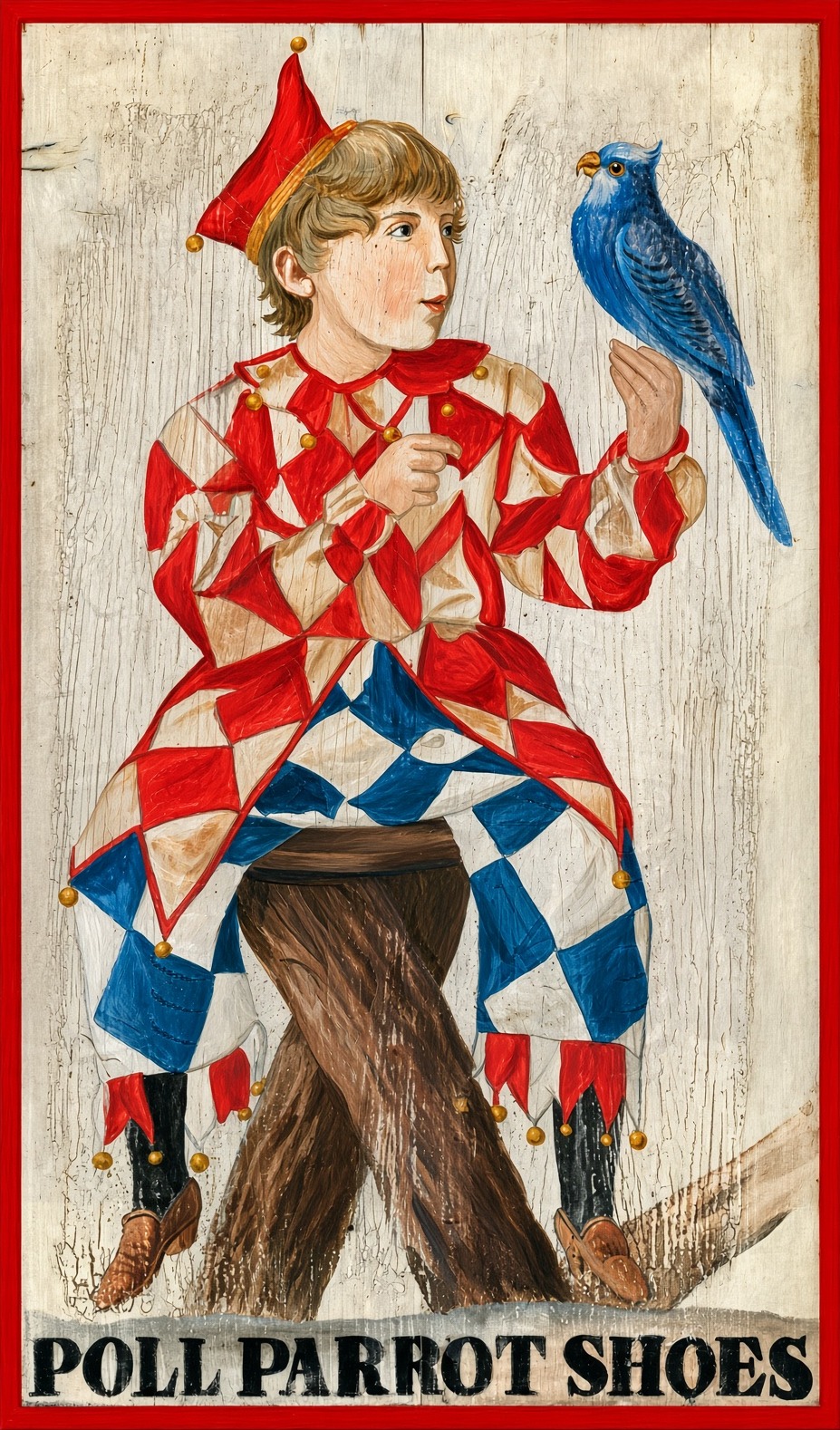
The harlequin and his parrot — a hand-painted Poll-Parrot store sign from the mascot years, when every St. Louis shoe brand kept a bird on a perch. 1920s–1950s
What we put on the foot
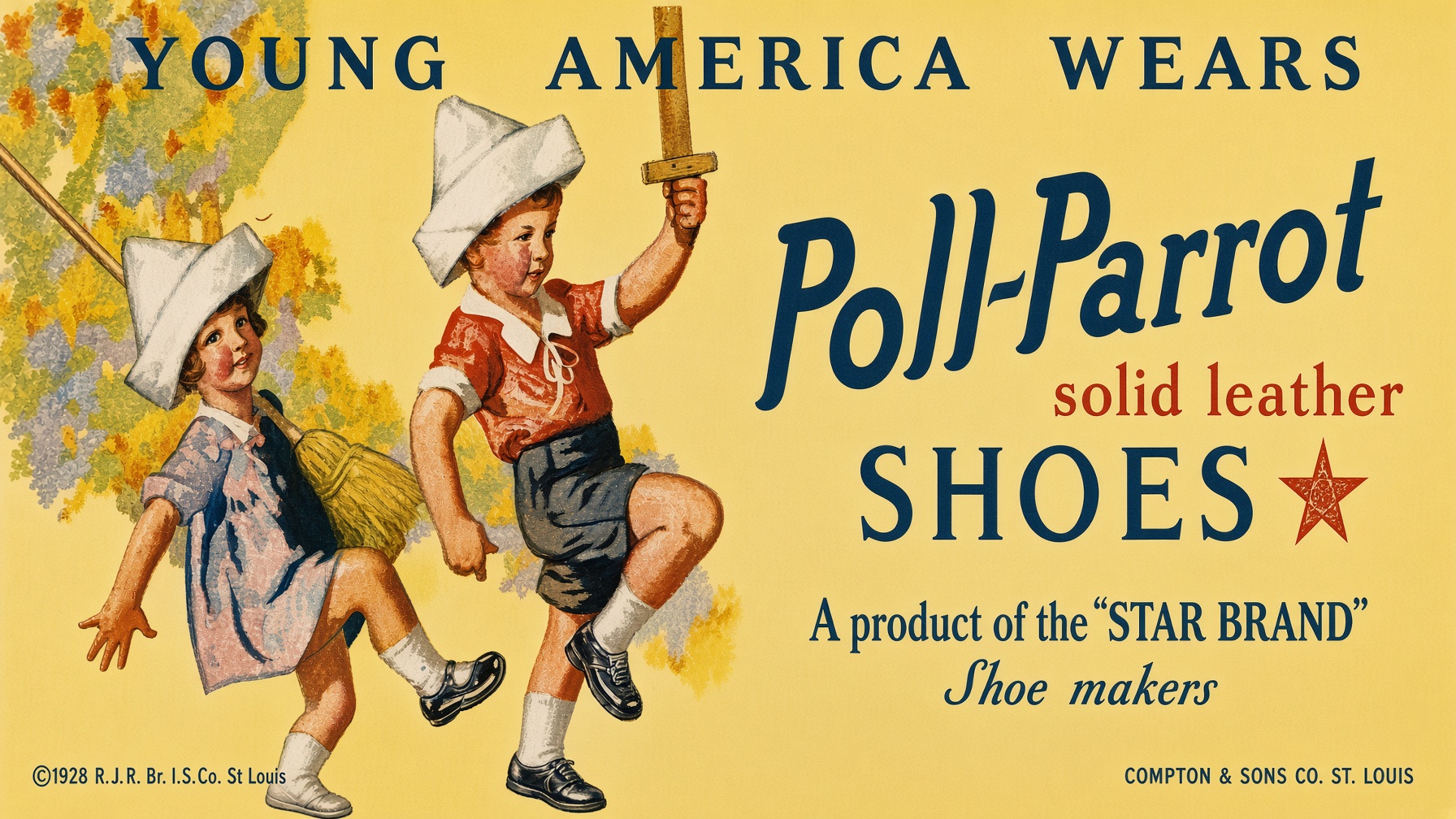
“Young America Wears Poll-Parrot” — an original Star Brand advertisement for Poll-Parrot solid leather shoes. A 1929 newspaper advertisement, parrot and all, said the quiet part:
“Properly fitted Poll-Parrot shoes will keep youngsters on their toes with pep every minute. Easily cleaned or polished, well made of fine leather and plenty flexible for growing little bones and muscles.”
That is still the product brief: fit first, leather that flexes, a shoe a child will actually wear. Later ads called them “pre-tested for cutting capers — and cutting budgets.” Traveling men carried sample trunks painted with the parrot.
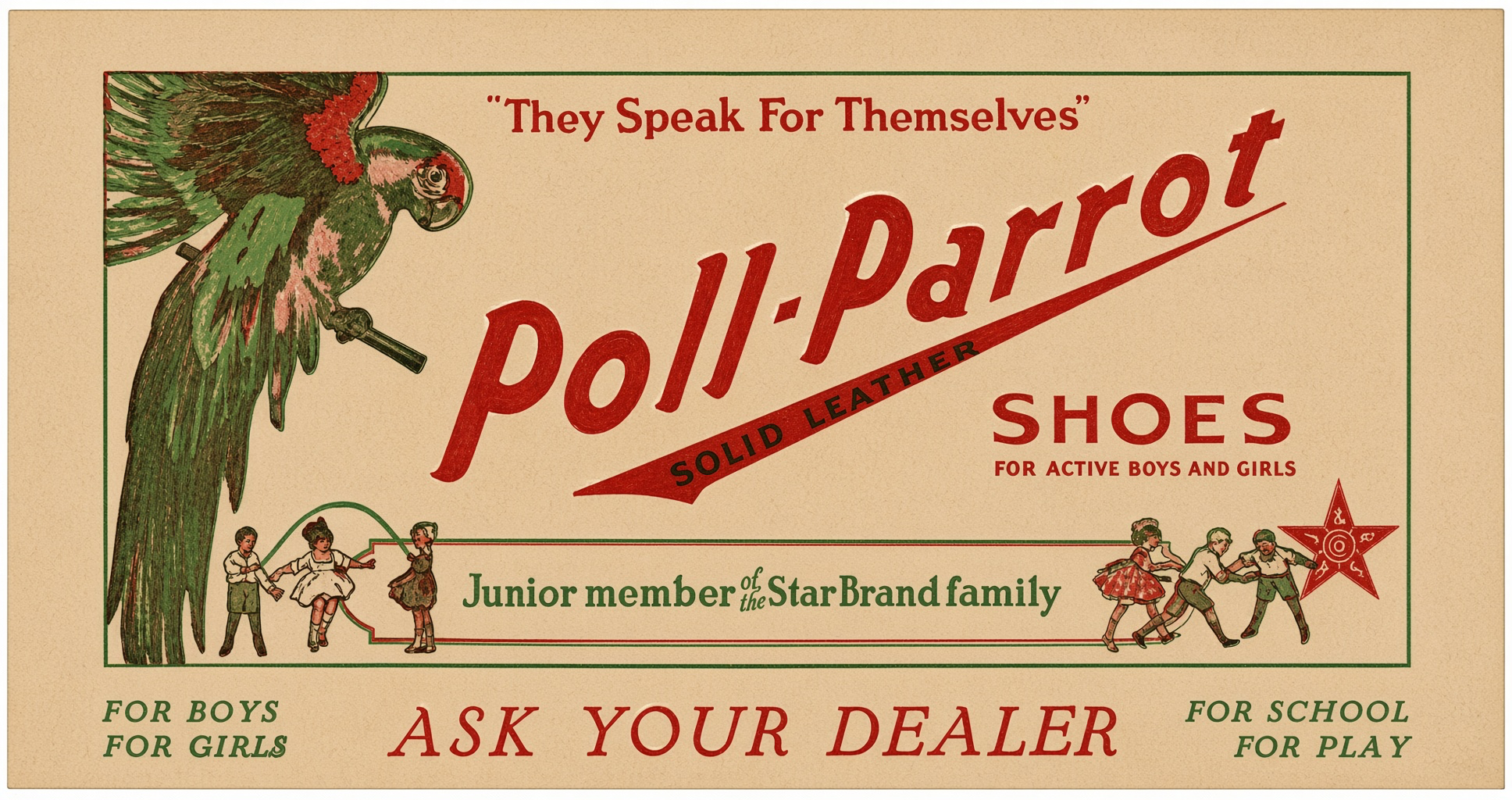
“They Speak For Themselves” — a Poll-Parrot dealer sign pairing the familiar parrot with solid-leather shoes for active boys and girls. 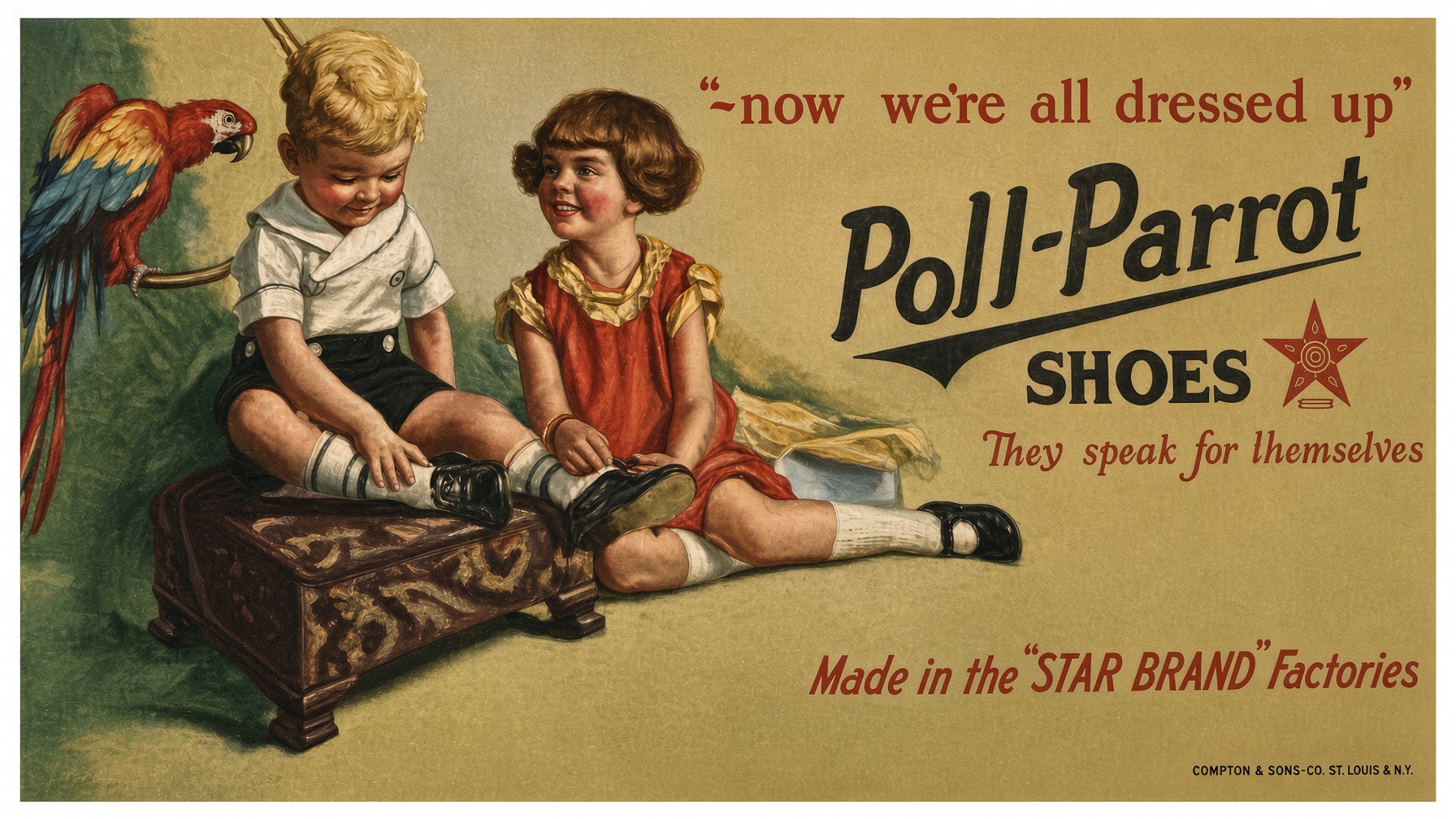
“Now we're all dressed up” — Sunday-best children lacing their Poll-Parrot shoes under the eye of the macaw, from the Star Brand factories. 1933–late 1950s
A little paper economy
In late 1933, at the depth of the Depression, Poll-Parrot introduced a premium that borrowed the authority of real currency without pretending to be it. International Shoe did not only talk to the parent who paid. It talked directly to the child who wore the shoe: “Save this Money and ask your family and friends to save it for you.”
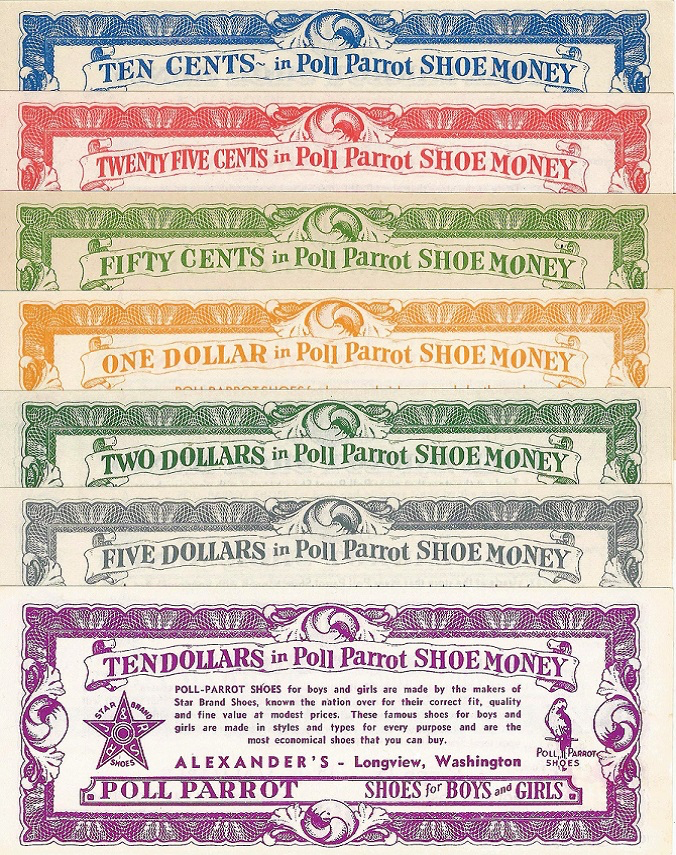
Poll-Parrot Shoe Money was issued in bright denominations and saved toward prizes at participating local shoe stores. The system was national in reach but local in operation. The manufacturer supplied the notes; participating dealers stamped or printed their own names and locations on them. A note could be exchanged only at the store that issued it, for prizes “which cannot be purchased with real money.” No surviving administrative record settles who financed those prizes, but the stores displayed, managed and redeemed them on site.
How it worked
- 01
A pair was bought
The local dealer paid out Shoe Money to the dollar and cent of the purchase.
- 02
Children saved it
Families and friends could pool the notes, building a reason to return to the same shop.
- 03
The shop exchanged it
Only the issuing dealer redeemed it, for prizes displayed and managed locally.
Seven denominations
- 10¢
- Blue
- 25¢
- Red
- 50¢
- Green
- $1
- Yellow
- $2
- Olive
- $5
- Gray
- $10
- Purple
Each note carried the Poll-Parrot bird and the five-pointed Star Brand emblem of Roberts, Johnson & Rand. The designs had no dates, serial numbers or printer's imprint. At least two versions survive: a monochrome series and another picked out in red ink, some bearing the words “All Leather.” Which came first remains unknown.
A 1933 list from the M & O Bootery in Oelwein, Iowa, is typical: a baseball glove at $35 in Shoe Money, football or roller skates at $37.50, a doll at $50 — when a pair of boys' oxfords sold for about $1.75 to $2.95. The point was pooling: “Save this Money and ask your family and friends to save it for you.” The program ran for about twenty-five years through independent shops across the country, while national Poll-Parrot advertisements rarely mentioned it.
By the late 1950s, retailers began replacing the distinctive notes with Poll-Parrot Gift Stamps redeemed through a premium catalog. A long-running Missouri dealer began issuing stamps in January 1959 and ended them in 1966 — the close of a small paper economy built around children, neighborhood shoe shops and the promise of a prize in the window.
Chapter sources include Boot and Shoe Recorder (1921), the Oelwein Daily Register (1933), and contemporary advertisements from Texas and Missouri.
- 01
1930s–1950s
Saturday: radio, then Howdy Doody
In the mid-to-late 1930s the brand syndicated The Cruise of the Poll Parrot, sold in thirteen-episode blocks. Setting: New Bedford, 1858, a whaler named for the mascot. A young St. Louis actor, Marvin Miller — later Michael Anthony on The Millionaire — voiced both the captain and the parrot. Surviving episodes are still in old-time radio collections.
In 1947 Poll-Parrot began sponsoring NBC's Howdy Doody Show — Buffalo Bob, Doodyville, the freckled puppet. Giveaway comics such as Poll Parrot's Howdy Doody put Howdy, Dilly Dally, Mr. Bluster and Polly the parrot on the same page. The bird had moved from shop perch to national living room.
1960s–1980s
After the golden hour
Shoe Money faded. The shoes did not — not at once. Poll-Parrot remained in stores through the 1960s, 1970s and into the 1980s. International Shoe diversified, became Interco in 1966 and eventually left footwear. Red Goose dropped away in the 1970s. Poll-Parrot advertising thinned and vanished around the late 1980s. Sneakers took the classroom. The old mascot war ended.
Paul Parrott outlived the peak of his own brand. He did not outlive the memory of it.
Today
The parrot returns to the perch
Poll-Parrot exists because that memory is not nostalgia alone. It is a brief: flexible construction for growing bones, color children recognize, a mascot that does not need a celebrity, and a name that already means “children's shoes” in American attics.
We honor Oneida, St. Louis, Hannibal, the dealers who stamped Shoe Money, the kids who saved it for a glove, and the families who heard the cruise of a fictional whaler and then bought a real pair.
The parrot still speaks for itself.
See the shoes